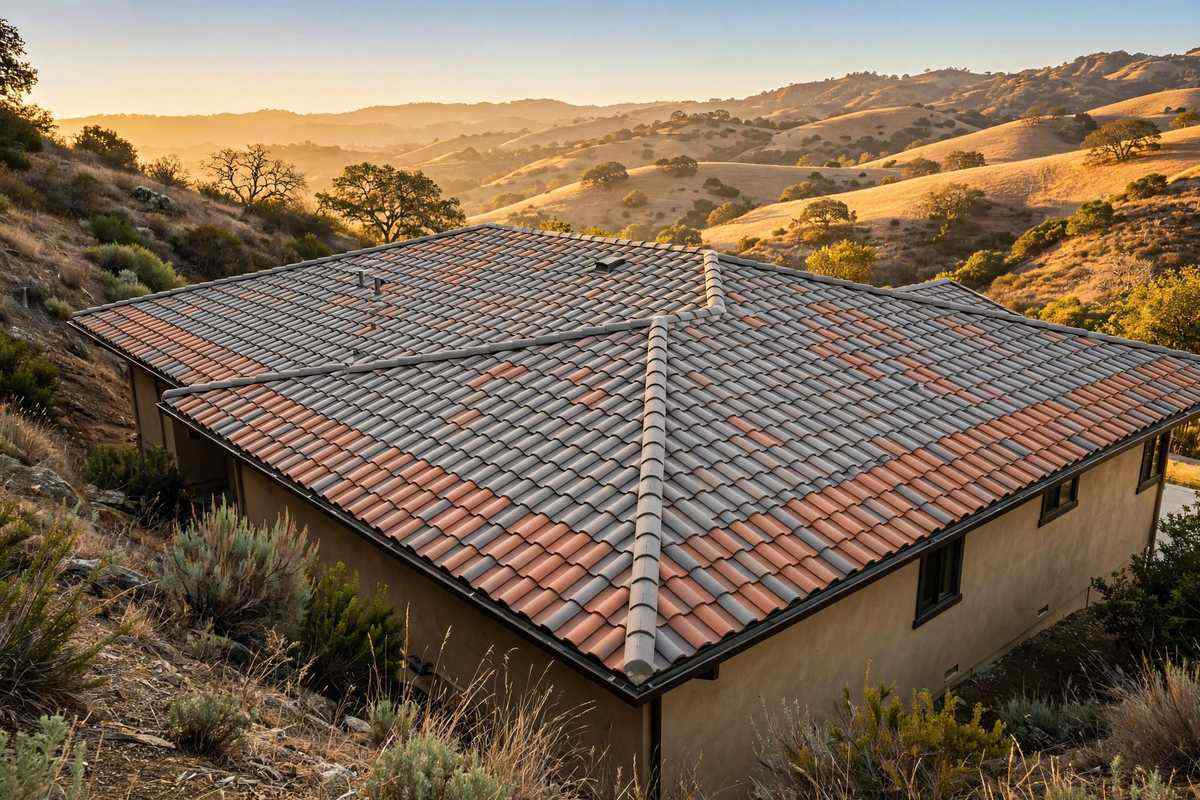
Tile and shingle answer different Simi Valley questions. Tile suits hillside and master-planned homes where profile, weight and fire detailing matter, and it outlives its underlayment. Shingle suits valley-floor tract homes where heat ageing and a second re-roof cycle are the story.
Tile vs shingle roofing in Simi Valley: which is better?
The honest tile comparison is tile lift-and-relay versus new tile, not tile versus shingle alone. Lift-and-relay reuses sound tile over new underlayment at $900 to $1,600 per square in the Torrance 2026 market guide, while new concrete tile is $1,100 to $1,900 per square and clay is higher. Those are market ranges, not this business's prices.
Simi Valley is an incorporated city in Ventura County, incorporated on 10 October 1969, and permits inside city limits run through the City of Simi Valley Building & Safety Division, not through LADBS. The City's own FAQ states that re-roofing of more than 10 percent of the total square footage of the roof, or over 100 square feet, requires a permit. A job can therefore need a City permit without triggering other code thresholds, and the permit route, the fee line and the inspection outcome are confirmed at application, not assumed from another city's rules.
For a single-family re-roof in CEC Climate Zone 9, the Title 24 Part 6 prescriptive cool-roof values are an aged solar reflectance of at least 0.20 with thermal emittance of at least 0.75, or an SRI of at least 16, on steep slopes of 2:12 or more, and at least 0.63 with emittance of at least 0.75, or an SRI of at least 75, on low slopes under 2:12. That requirement is triggered when more than 50 percent of the roof area is replaced, which is a different threshold from the City permit trigger, and the parcel's zone should be checked with the CEC zone finder before a product is specified.
The short answer: tile vs shingle in Simi Valley
Simi Valley contains High and Very High Fire Hazard Severity Zone parcels, but it is not correct to say that all of Simi Valley is Very High. The parcel's zone must be checked in the CAL FIRE / VCFD Fire Hazard Severity Zone viewer, and on a wildland-urban interface parcel the current citation is Title 24 Part 7, the California Wildland-Urban Interface Code, not the retired CBC Chapter 7A. On such a parcel a Class A fire-rated roof assembly is required.
Tile and shingle answer different Simi Valley questions. Tile suits hillside and master-planned homes where profile, weight and fire detailing matter, and it outlives its underlayment. Shingle suits valley-floor tract homes where heat ageing and a second re-roof cycle are the story.
The honest tile comparison is tile lift-and-relay versus new tile, not tile versus shingle alone. Lift-and-relay reuses sound tile over new underlayment at $900 to $1,600 per square in the Torrance 2026 market guide, while new concrete tile is $1,100 to $1,900 per square and clay is higher. Those are market ranges, not this business's prices.
How Simi Valley's climate stresses a roof
Shingle, by contrast, is replaced as a system: covering, underlayment, flashing and ventilation together, with Climate Zone 9 cool-roof values on a full re-roof. The better material is the one that suits the home's era, slope, structure and fire-zone status.
Simi Valley is an incorporated city in Ventura County, incorporated on 10 October 1969, and permits inside city limits run through the City of Simi Valley Building & Safety Division, not through LADBS. The City's own FAQ states that re-roofing of more than 10 percent of the total square footage of the roof, or over 100 square feet, requires a permit. A job can therefore need a City permit without triggering other code thresholds, and the permit route, the fee line and the inspection outcome are confirmed at application, not assumed from another city's rules.
For a single-family re-roof in CEC Climate Zone 9, the Title 24 Part 6 prescriptive cool-roof values are an aged solar reflectance of at least 0.20 with thermal emittance of at least 0.75, or an SRI of at least 16, on steep slopes of 2:12 or more, and at least 0.63 with emittance of at least 0.75, or an SRI of at least 75, on low slopes under 2:12. That requirement is triggered when more than 50 percent of the roof area is replaced, which is a different threshold from the City permit trigger, and the parcel's zone should be checked with the CEC zone finder before a product is specified.
Simi Valley contains High and Very High Fire Hazard Severity Zone parcels, but it is not correct to say that all of Simi Valley is Very High. The parcel's zone must be checked in the CAL FIRE / VCFD Fire Hazard Severity Zone viewer, and on a wildland-urban interface parcel the current citation is Title 24 Part 7, the California Wildland-Urban Interface Code, not the retired CBC Chapter 7A. On such a parcel a Class A fire-rated roof assembly is required.
Tile and shingle answer different Simi Valley questions. Tile suits hillside and master-planned homes where profile, weight and fire detailing matter, and it outlives its underlayment. Shingle suits valley-floor tract homes where heat ageing and a second re-roof cycle are the story.
Tile roofing in Simi Valley: strengths and trade-offs
The honest tile comparison is tile lift-and-relay versus new tile, not tile versus shingle alone. Lift-and-relay reuses sound tile over new underlayment at $900 to $1,600 per square in the Torrance 2026 market guide, while new concrete tile is $1,100 to $1,900 per square and clay is higher. Those are market ranges, not this business's prices.
What tile does well
- Lifespan: 50 years for concrete tile, 50 to 75 for clay, and 75 to 100 for natural slate.
- Heat: Tile reflects and radiates heat; attic temperatures under tile run 10°F to 20°F cooler than under dark shingles.
- Fire: Class A rating with no added chemicals.
- Curb appeal: Spanish S-tile and flat concrete profiles fit the Mission-style and Mediterranean homes common across Simi Valley.
- Maintenance: Occasional broken-tile swaps and flashing checks; no granule loss, no curling.
What tile costs you
Shingle, by contrast, is replaced as a system: covering, underlayment, flashing and ventilation together, with Climate Zone 9 cool-roof values on a full re-roof. The better material is the one that suits the home's era, slope, structure and fire-zone status.
Simi Valley is an incorporated city in Ventura County, incorporated on 10 October 1969, and permits inside city limits run through the City of Simi Valley Building & Safety Division, not through LADBS. The City's own FAQ states that re-roofing of more than 10 percent of the total square footage of the roof, or over 100 square feet, requires a permit. A job can therefore need a City permit without triggering other code thresholds, and the permit route, the fee line and the inspection outcome are confirmed at application, not assumed from another city's rules.
For a single-family re-roof in CEC Climate Zone 9, the Title 24 Part 6 prescriptive cool-roof values are an aged solar reflectance of at least 0.20 with thermal emittance of at least 0.75, or an SRI of at least 16, on steep slopes of 2:12 or more, and at least 0.63 with emittance of at least 0.75, or an SRI of at least 75, on low slopes under 2:12. That requirement is triggered when more than 50 percent of the roof area is replaced, which is a different threshold from the City permit trigger, and the parcel's zone should be checked with the CEC zone finder before a product is specified.
Shingle roofing in Simi Valley: strengths and trade-offs
Simi Valley contains High and Very High Fire Hazard Severity Zone parcels, but it is not correct to say that all of Simi Valley is Very High. The parcel's zone must be checked in the CAL FIRE / VCFD Fire Hazard Severity Zone viewer, and on a wildland-urban interface parcel the current citation is Title 24 Part 7, the California Wildland-Urban Interface Code, not the retired CBC Chapter 7A. On such a parcel a Class A fire-rated roof assembly is required.
What shingles do well
- Upfront cost: Roughly half the installed cost of tile.
- Weight: 2 to 3 pounds per square foot, so no structural work is usually needed.
- Repair speed: A wind-damaged section can be patched in an afternoon.
- Options: Architectural and dimensional shingles now carry 30-year, 40-year, and even 50-year manufacturer warranties.
- Fire rating: Class A assemblies are available and required in the high-fire zones here.
What shingles cost you
Tile and shingle answer different Simi Valley questions. Tile suits hillside and master-planned homes where profile, weight and fire detailing matter, and it outlives its underlayment. Shingle suits valley-floor tract homes where heat ageing and a second re-roof cycle are the story.
The honest tile comparison is tile lift-and-relay versus new tile, not tile versus shingle alone. Lift-and-relay reuses sound tile over new underlayment at $900 to $1,600 per square in the Torrance 2026 market guide, while new concrete tile is $1,100 to $1,900 per square and clay is higher. Those are market ranges, not this business's prices.
Shingle, by contrast, is replaced as a system: covering, underlayment, flashing and ventilation together, with Climate Zone 9 cool-roof values on a full re-roof. The better material is the one that suits the home's era, slope, structure and fire-zone status.
Tile or shingle roof cost in Simi Valley
Simi Valley is an incorporated city in Ventura County, incorporated on 10 October 1969, and permits inside city limits run through the City of Simi Valley Building & Safety Division, not through LADBS. The City's own FAQ states that re-roofing of more than 10 percent of the total square footage of the roof, or over 100 square feet, requires a permit. A job can therefore need a City permit without triggering other code thresholds, and the permit route, the fee line and the inspection outcome are confirmed at application, not assumed from another city's rules.
- Asphalt shingle reroof: $5 to $9 per square foot installed, or roughly $12,000 to $22,000 for a 2,000 square foot roof.
- Concrete tile reroof: $12 to $18 per square foot installed, or roughly $24,000 to $40,000.
- Clay tile reroof: $16 to $25 per square foot installed, or roughly $32,000 to $55,000.
- Structural upgrades for tile: $3,000 to $12,000 if rafters need reinforcement.
- Tear-off and disposal: $1.50 to $3.00 per square foot, higher if there are two or more old layers.
For a single-family re-roof in CEC Climate Zone 9, the Title 24 Part 6 prescriptive cool-roof values are an aged solar reflectance of at least 0.20 with thermal emittance of at least 0.75, or an SRI of at least 16, on steep slopes of 2:12 or more, and at least 0.63 with emittance of at least 0.75, or an SRI of at least 75, on low slopes under 2:12. That requirement is triggered when more than 50 percent of the roof area is replaced, which is a different threshold from the City permit trigger, and the parcel's zone should be checked with the CEC zone finder before a product is specified.
Simi Valley contains High and Very High Fire Hazard Severity Zone parcels, but it is not correct to say that all of Simi Valley is Very High. The parcel's zone must be checked in the CAL FIRE / VCFD Fire Hazard Severity Zone viewer, and on a wildland-urban interface parcel the current citation is Title 24 Part 7, the California Wildland-Urban Interface Code, not the retired CBC Chapter 7A. On such a parcel a Class A fire-rated roof assembly is required.
Which roof lasts longer in Simi Valley, California?
Tile and shingle answer different Simi Valley questions. Tile suits hillside and master-planned homes where profile, weight and fire detailing matter, and it outlives its underlayment. Shingle suits valley-floor tract homes where heat ageing and a second re-roof cycle are the story.
The honest tile comparison is tile lift-and-relay versus new tile, not tile versus shingle alone. Lift-and-relay reuses sound tile over new underlayment at $900 to $1,600 per square in the Torrance 2026 market guide, while new concrete tile is $1,100 to $1,900 per square and clay is higher. Those are market ranges, not this business's prices.
- Solar exposure. South and west slopes age fastest. Shade from a mature oak can add 5 years to a shingle roof.
- Attic ventilation. Poor ventilation traps heat and cooks the underside of the deck. Proper intake and exhaust vents can add years to either material.
- Flashing and penetrations. Most leaks we find are not the field of the roof - they are pipe boots, valleys, and chimney flashing.
Shingle, by contrast, is replaced as a system: covering, underlayment, flashing and ventilation together, with Climate Zone 9 cool-roof values on a full re-roof. The better material is the one that suits the home's era, slope, structure and fire-zone status.
What is the best roofing material for Simi Valley CA?
Simi Valley is an incorporated city in Ventura County, incorporated on 10 October 1969, and permits inside city limits run through the City of Simi Valley Building & Safety Division, not through LADBS. The City's own FAQ states that re-roofing of more than 10 percent of the total square footage of the roof, or over 100 square feet, requires a permit. A job can therefore need a City permit without triggering other code thresholds, and the permit route, the fee line and the inspection outcome are confirmed at application, not assumed from another city's rules.
For a single-family re-roof in CEC Climate Zone 9, the Title 24 Part 6 prescriptive cool-roof values are an aged solar reflectance of at least 0.20 with thermal emittance of at least 0.75, or an SRI of at least 16, on steep slopes of 2:12 or more, and at least 0.63 with emittance of at least 0.75, or an SRI of at least 75, on low slopes under 2:12. That requirement is triggered when more than 50 percent of the roof area is replaced, which is a different threshold from the City permit trigger, and the parcel's zone should be checked with the CEC zone finder before a product is specified.
- You plan to own the home for 15+ years.
- Your roof structure is rated for the load or can be reinforced.
- You want maximum fire resistance and the lowest long-term cost.
- Your home's architecture suits tile - Spanish, Mediterranean, or ranch with a low pitch.
Simi Valley contains High and Very High Fire Hazard Severity Zone parcels, but it is not correct to say that all of Simi Valley is Very High. The parcel's zone must be checked in the CAL FIRE / VCFD Fire Hazard Severity Zone viewer, and on a wildland-urban interface parcel the current citation is Title 24 Part 7, the California Wildland-Urban Interface Code, not the retired CBC Chapter 7A. On such a parcel a Class A fire-rated roof assembly is required.
- Upfront budget is the deciding factor.
- Your framing was not built for heavy tile and you do not want structural work.
- You plan to sell within 10 years and want a clean, warrantied roof now.
- You need a fast reroof - shingle installs are quicker and less disruptive.
Tile and shingle answer different Simi Valley questions. Tile suits hillside and master-planned homes where profile, weight and fire detailing matter, and it outlives its underlayment. Shingle suits valley-floor tract homes where heat ageing and a second re-roof cycle are the story.
Common mistakes we see on Simi Valley roofs
The honest tile comparison is tile lift-and-relay versus new tile, not tile versus shingle alone. Lift-and-relay reuses sound tile over new underlayment at $900 to $1,600 per square in the Torrance 2026 market guide, while new concrete tile is $1,100 to $1,900 per square and clay is higher. Those are market ranges, not this business's prices.
- Laying tile over a roof that cannot carry it. We have seen sagging ridges and cracked ceiling drywall from tile installed on shingle-rated framing.
- Skipping the underlayment upgrade. If you are spending $30,000 on tile, do not let anyone talk you into 15-pound felt. Synthetic underlayment costs a little more and lasts decades longer.
- Mismatched tile. After a windstorm, homeowners grab whatever tile is at the yard. Color and profile drift over the years, and a mismatched patch is visible from the street.
- Ignoring attic ventilation. A hot attic kills shingles from below. We add ridge and soffit venting on most reroofs for exactly this reason.
- Patching instead of diagnosing. A ceiling stain in January is usually a flashing or pipe-boot failure, not a field shingle problem. Patching the wrong spot wastes money.
Shingle, by contrast, is replaced as a system: covering, underlayment, flashing and ventilation together, with Climate Zone 9 cool-roof values on a full re-roof. The better material is the one that suits the home's era, slope, structure and fire-zone status.
When to call a professional
Simi Valley is an incorporated city in Ventura County, incorporated on 10 October 1969, and permits inside city limits run through the City of Simi Valley Building & Safety Division, not through LADBS. The City's own FAQ states that re-roofing of more than 10 percent of the total square footage of the roof, or over 100 square feet, requires a permit. A job can therefore need a City permit without triggering other code thresholds, and the permit route, the fee line and the inspection outcome are confirmed at application, not assumed from another city's rules.
For a single-family re-roof in CEC Climate Zone 9, the Title 24 Part 6 prescriptive cool-roof values are an aged solar reflectance of at least 0.20 with thermal emittance of at least 0.75, or an SRI of at least 16, on steep slopes of 2:12 or more, and at least 0.63 with emittance of at least 0.75, or an SRI of at least 75, on low slopes under 2:12. That requirement is triggered when more than 50 percent of the roof area is replaced, which is a different threshold from the City permit trigger, and the parcel's zone should be checked with the CEC zone finder before a product is specified.
Simi Valley contains High and Very High Fire Hazard Severity Zone parcels, but it is not correct to say that all of Simi Valley is Very High. The parcel's zone must be checked in the CAL FIRE / VCFD Fire Hazard Severity Zone viewer, and on a wildland-urban interface parcel the current citation is Title 24 Part 7, the California Wildland-Urban Interface Code, not the retired CBC Chapter 7A. On such a parcel a Class A fire-rated roof assembly is required.
Tile and shingle answer different Simi Valley questions. Tile suits hillside and master-planned homes where profile, weight and fire detailing matter, and it outlives its underlayment. Shingle suits valley-floor tract homes where heat ageing and a second re-roof cycle are the story.
Frequently Asked Questions
Is tile or shingle roofing better in Simi Valley CA?
The honest tile comparison is tile lift-and-relay versus new tile, not tile versus shingle alone. Lift-and-relay reuses sound tile over new underlayment at $900 to $1,600 per square in the Torrance 2026 market guide, while new concrete tile is $1,100 to $1,900 per square and clay is higher. Those are market ranges, not this business's prices.
How much more does tile roofing cost than shingle in Simi Valley?
Shingle, by contrast, is replaced as a system: covering, underlayment, flashing and ventilation together, with Climate Zone 9 cool-roof values on a full re-roof. The better material is the one that suits the home's era, slope, structure and fire-zone status.
Which roof lasts longer in Simi Valley California?
Simi Valley is an incorporated city in Ventura County, incorporated on 10 October 1969, and permits inside city limits run through the City of Simi Valley Building & Safety Division, not through LADBS. The City's own FAQ states that re-roofing of more than 10 percent of the total square footage of the roof, or over 100 square feet, requires a permit. A job can therefore need a City permit without triggering other code thresholds, and the permit route, the fee line and the inspection outcome are confirmed at application, not assumed from another city's rules.
What is the best roofing material for Simi Valley CA?
For a single-family re-roof in CEC Climate Zone 9, the Title 24 Part 6 prescriptive cool-roof values are an aged solar reflectance of at least 0.20 with thermal emittance of at least 0.75, or an SRI of at least 16, on steep slopes of 2:12 or more, and at least 0.63 with emittance of at least 0.75, or an SRI of at least 75, on low slopes under 2:12. That requirement is triggered when more than 50 percent of the roof area is replaced, which is a different threshold from the City permit trigger, and the parcel's zone should be checked with the CEC zone finder before a product is specified.
Can I put tile on a roof that currently has shingles?
Simi Valley contains High and Very High Fire Hazard Severity Zone parcels, but it is not correct to say that all of Simi Valley is Very High. The parcel's zone must be checked in the CAL FIRE / VCFD Fire Hazard Severity Zone viewer, and on a wildland-urban interface parcel the current citation is Title 24 Part 7, the California Wildland-Urban Interface Code, not the retired CBC Chapter 7A. On such a parcel a Class A fire-rated roof assembly is required.
Get help with Roofing in Simi Valley
Tile and shingle answer different Simi Valley questions. Tile suits hillside and master-planned homes where profile, weight and fire detailing matter, and it outlives its underlayment. Shingle suits valley-floor tract homes where heat ageing and a second re-roof cycle are the story.