
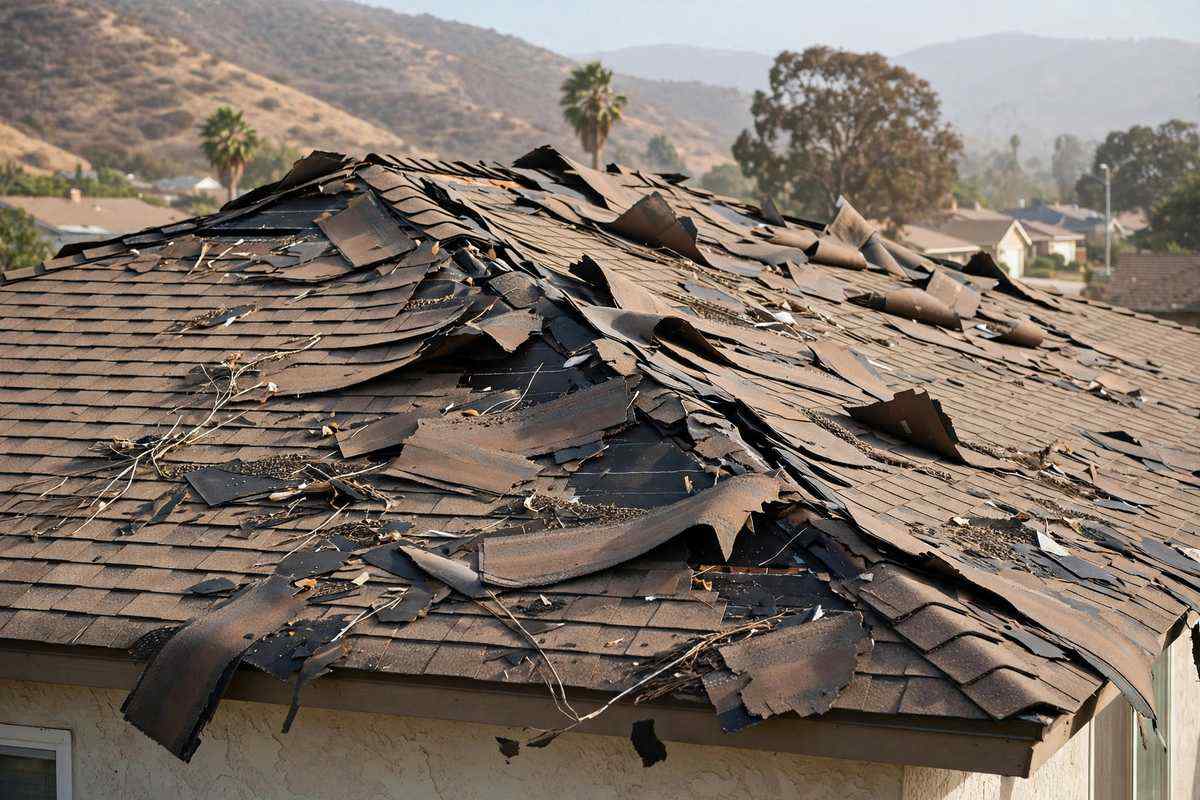
After a Simi Valley storm, check the roof from the ground first: missing or lifted shingles and tiles, displaced ridge caps, debris in valleys and gutters, and new interior stains. Photograph everything before temporary repairs disturb it.
How to spot storm damage on your roof after a Simi Valley storm
Santa Ana wind damage looks different from winter-rain damage. Wind lifts ridge caps and tabs and drives debris; rain finds valleys, flashings and failed underlayment. Both can appear on the same roof after the same season, and both are documented separately.
Simi Valley contains High and Very High Fire Hazard Severity Zone parcels, but it is not correct to say that all of Simi Valley is Very High. The parcel's zone must be checked in the CAL FIRE / VCFD Fire Hazard Severity Zone viewer, and on a wildland-urban interface parcel the current citation is Title 24 Part 7, the California Wildland-Urban Interface Code, not the retired CBC Chapter 7A. On such a parcel a Class A fire-rated roof assembly is required.
Published regional market ranges include architectural asphalt at $550 to $900 per square and tile re-lay at $900 to $1,600 per square in a Torrance / South Bay 2026 guide, and California repair work most commonly at $450 to $3,200 in a Modernize guide updated 26 August 2026. One square is 100 square feet of roof surface, not floor area, and a written estimate follows inspection of the actual roof.
Simi Valley is an ageing tract re-roof market, not a new-construction market. Most Simi Valley homes were built in the 1960s and the 1980s, with a median construction year in the late 1970s. A large share of roofs therefore sit on homes 35 to 65 years old, at or beyond a first or second re-roof cycle on age grounds alone, so each roof still needs its own inspection.
Start with a ground-level scan
After a Simi Valley storm, check the roof from the ground first: missing or lifted shingles and tiles, displaced ridge caps, debris in valleys and gutters, and new interior stains. Photograph everything before temporary repairs disturb it.
Santa Ana wind damage looks different from winter-rain damage. Wind lifts ridge caps and tabs and drives debris; rain finds valleys, flashings and failed underlayment. Both can appear on the same roof after the same season, and both are documented separately.
- Shingle granules piling up at the base of downspouts - a handful after a storm is normal, a coffee can's worth is not.
- Whole shingle tabs or torn pieces of underlayment in the yard.
- Bent or missing gutter sections, which usually mean wind got under the roof edge.
- Dented downspouts, AC units, or fence caps - a sign of hail larger than 1 inch.
- Debris on the roof itself: palm fronds, oak branches, or eucalyptus limbs that landed and stayed.
This post describes what to look for on your own roof, and when to call for an inspection.
What does storm damage look like on a roof in Simi Valley California?
Simi Valley contains High and Very High Fire Hazard Severity Zone parcels, but it is not correct to say that all of Simi Valley is Very High. The parcel's zone must be checked in the CAL FIRE / VCFD Fire Hazard Severity Zone viewer, and on a wildland-urban interface parcel the current citation is Title 24 Part 7, the California Wildland-Urban Interface Code, not the retired CBC Chapter 7A. On such a parcel a Class A fire-rated roof assembly is required.
Published regional market ranges include architectural asphalt at $550 to $900 per square and tile re-lay at $900 to $1,600 per square in a Torrance / South Bay 2026 guide, and California repair work most commonly at $450 to $3,200 in a Modernize guide updated 26 August 2026. One square is 100 square feet of roof surface, not floor area, and a written estimate follows inspection of the actual roof.
Wind damage
Simi Valley is an ageing tract re-roof market, not a new-construction market. Most Simi Valley homes were built in the 1960s and the 1980s, with a median construction year in the late 1970s. A large share of roofs therefore sit on homes 35 to 65 years old, at or beyond a first or second re-roof cycle on age grounds alone, so each roof still needs its own inspection.
Hail damage
After a Simi Valley storm, check the roof from the ground first: missing or lifted shingles and tiles, displaced ridge caps, debris in valleys and gutters, and new interior stains. Photograph everything before temporary repairs disturb it.
Water and debris damage
Santa Ana wind damage looks different from winter-rain damage. Wind lifts ridge caps and tabs and drives debris; rain finds valleys, flashings and failed underlayment. Both can appear on the same roof after the same season, and both are documented separately.
How do I spot storm damage on my roof in Simi Valley CA?
This post describes what to look for on your own roof, and when to call for an inspection.
Simi Valley contains High and Very High Fire Hazard Severity Zone parcels, but it is not correct to say that all of Simi Valley is Very High. The parcel's zone must be checked in the CAL FIRE / VCFD Fire Hazard Severity Zone viewer, and on a wildland-urban interface parcel the current citation is Title 24 Part 7, the California Wildland-Urban Interface Code, not the retired CBC Chapter 7A. On such a parcel a Class A fire-rated roof assembly is required.
- Binoculars from the street. Look at the ridge line, the valleys, and the slope facing the direction the wind came from. Missing shingles and lifted tabs show up first there.
- Second-story window. If you have a bedroom or bathroom window facing the roof, open it and look across the slope. You will see granule loss and dark patches you cannot see from the ground.
- Attic flashlight check. Look at the underside of the roof deck for water stains, dark rings around nail tips, and daylight poking through.
- Ceiling and wall check. Look for new brown rings, bubbling paint, or a musty smell in upstairs rooms.
- Gutter and downspout check. Clogged gutters after a storm usually mean shingle debris came off the roof. If your gutters are pulling away from the fascia, that is a wind or water-loading problem.
Published regional market ranges include architectural asphalt at $550 to $900 per square and tile re-lay at $900 to $1,600 per square in a Torrance / South Bay 2026 guide, and California repair work most commonly at $450 to $3,200 in a Modernize guide updated 26 August 2026. One square is 100 square feet of roof surface, not floor area, and a written estimate follows inspection of the actual roof.
Check the attic and ceilings for hidden leaks
Simi Valley is an ageing tract re-roof market, not a new-construction market. Most Simi Valley homes were built in the 1960s and the 1980s, with a median construction year in the late 1970s. A large share of roofs therefore sit on homes 35 to 65 years old, at or beyond a first or second re-roof cycle on age grounds alone, so each roof still needs its own inspection.
After a Simi Valley storm, check the roof from the ground first: missing or lifted shingles and tiles, displaced ridge caps, debris in valleys and gutters, and new interior stains. Photograph everything before temporary repairs disturb it.
- Dark or discolored wood on the underside of the roof deck.
- White or gray chalky streaks on the rafters - that is efflorescence, a sign of repeated moisture.
- Rust on nail tips or on the metal hangers holding your rafters.
- Daylight visible through the roof boards.
- Damp or compressed insulation, especially near chimneys and vents.
Santa Ana wind damage looks different from winter-rain damage. Wind lifts ridge caps and tabs and drives debris; rain finds valleys, flashings and failed underlayment. Both can appear on the same roof after the same season, and both are documented separately.
This post describes what to look for on your own roof, and when to call for an inspection.
The parts of your roof that fail first
Simi Valley contains High and Very High Fire Hazard Severity Zone parcels, but it is not correct to say that all of Simi Valley is Very High. The parcel's zone must be checked in the CAL FIRE / VCFD Fire Hazard Severity Zone viewer, and on a wildland-urban interface parcel the current citation is Title 24 Part 7, the California Wildland-Urban Interface Code, not the retired CBC Chapter 7A. On such a parcel a Class A fire-rated roof assembly is required.
Flashing and penetrations
Published regional market ranges include architectural asphalt at $550 to $900 per square and tile re-lay at $900 to $1,600 per square in a Torrance / South Bay 2026 guide, and California repair work most commonly at $450 to $3,200 in a Modernize guide updated 26 August 2026. One square is 100 square feet of roof surface, not floor area, and a written estimate follows inspection of the actual roof.
Ridge caps and hip lines
Simi Valley is an ageing tract re-roof market, not a new-construction market. Most Simi Valley homes were built in the 1960s and the 1980s, with a median construction year in the late 1970s. A large share of roofs therefore sit on homes 35 to 65 years old, at or beyond a first or second re-roof cycle on age grounds alone, so each roof still needs its own inspection.
Valleys
After a Simi Valley storm, check the roof from the ground first: missing or lifted shingles and tiles, displaced ridge caps, debris in valleys and gutters, and new interior stains. Photograph everything before temporary repairs disturb it.
Gutters and fascia
Santa Ana wind damage looks different from winter-rain damage. Wind lifts ridge caps and tabs and drives debris; rain finds valleys, flashings and failed underlayment. Both can appear on the same roof after the same season, and both are documented separately.
Common mistakes homeowners make after a storm
This post describes what to look for on your own roof, and when to call for an inspection.
Simi Valley contains High and Very High Fire Hazard Severity Zone parcels, but it is not correct to say that all of Simi Valley is Very High. The parcel's zone must be checked in the CAL FIRE / VCFD Fire Hazard Severity Zone viewer, and on a wildland-urban interface parcel the current citation is Title 24 Part 7, the California Wildland-Urban Interface Code, not the retired CBC Chapter 7A. On such a parcel a Class A fire-rated roof assembly is required.
- Climbing on the roof to check it yourself. Wet shingles and tile are slick, and a fall costs more than any inspection. Stay on the ground.
- Assuming no visible damage means no damage. Wind damage often lifts shingles without tearing them off. The seal is broken, but the shingle is still in place.
- Filing an insurance claim before getting a professional opinion. A roofer can tell you whether the damage is storm-related or wear-and-tear, which matters for the claim.
- Patching with caulk or tar. It works for a weekend. It fails by the next rain, and it can void a manufacturer written scope terms.
- Ignoring the gutters. Clogged gutters back water up under the roof edge and rot the fascia. That is a $400 problem that becomes a $4,000 problem.
Published regional market ranges include architectural asphalt at $550 to $900 per square and tile re-lay at $900 to $1,600 per square in a Torrance / South Bay 2026 guide, and California repair work most commonly at $450 to $3,200 in a Modernize guide updated 26 August 2026. One square is 100 square feet of roof surface, not floor area, and a written estimate follows inspection of the actual roof.
When to call a professional
Simi Valley is an ageing tract re-roof market, not a new-construction market. Most Simi Valley homes were built in the 1960s and the 1980s, with a median construction year in the late 1970s. A large share of roofs therefore sit on homes 35 to 65 years old, at or beyond a first or second re-roof cycle on age grounds alone, so each roof still needs its own inspection.
After a Simi Valley storm, check the roof from the ground first: missing or lifted shingles and tiles, displaced ridge caps, debris in valleys and gutters, and new interior stains. Photograph everything before temporary repairs disturb it.
Santa Ana wind damage looks different from winter-rain damage. Wind lifts ridge caps and tabs and drives debris; rain finds valleys, flashings and failed underlayment. Both can appear on the same roof after the same season, and both are documented separately.
Frequently Asked Questions
How do I spot storm damage on my roof in Simi Valley CA?
This post describes what to look for on your own roof, and when to call for an inspection.
What does storm damage look like on a roof in Simi Valley California?
Simi Valley contains High and Very High Fire Hazard Severity Zone parcels, but it is not correct to say that all of Simi Valley is Very High. The parcel's zone must be checked in the CAL FIRE / VCFD Fire Hazard Severity Zone viewer, and on a wildland-urban interface parcel the current citation is Title 24 Part 7, the California Wildland-Urban Interface Code, not the retired CBC Chapter 7A. On such a parcel a Class A fire-rated roof assembly is required.
Should I get a roof inspection after a storm in Simi Valley?
Published regional market ranges include architectural asphalt at $550 to $900 per square and tile re-lay at $900 to $1,600 per square in a Torrance / South Bay 2026 guide, and California repair work most commonly at $450 to $3,200 in a Modernize guide updated 26 August 2026. One square is 100 square feet of roof surface, not floor area, and a written estimate follows inspection of the actual roof.
Does insurance cover storm damage in Simi Valley CA?
Simi Valley is an ageing tract re-roof market, not a new-construction market. Most Simi Valley homes were built in the 1960s and the 1980s, with a median construction year in the late 1970s. A large share of roofs therefore sit on homes 35 to 65 years old, at or beyond a first or second re-roof cycle on age grounds alone, so each roof still needs its own inspection.
How long after a storm can I file a claim?
After a Simi Valley storm, check the roof from the ground first: missing or lifted shingles and tiles, displaced ridge caps, debris in valleys and gutters, and new interior stains. Photograph everything before temporary repairs disturb it.
Get help with Roofing in Simi Valley
Santa Ana wind damage looks different from winter-rain damage. Wind lifts ridge caps and tabs and drives debris; rain finds valleys, flashings and failed underlayment. Both can appear on the same roof after the same season, and both are documented separately.